


Ansys Medini Analyze
Safety-Critical Electronic Analysis Software

Ansys medini analyze
Ansys medini analyze software implements key safety analysis methods — hazard and operability (HAZOP) analysis, fault tree analysis (FTA), failure modes and effects analysis (FMEA), failure modes, effects and diagnostic analysis (FMEDA) — all in one integrated tool. It supports the efficient and consistent execution of the safety-related activities required by applicable safety standards. Ansys medini analyze is well integrated with other engineering tools, and enables model-based safety analysis using standards like SysML.
Ansys medini Overview Video
Customers who use Medini Analyze report a 30% - 50% decrease in efforts for functional safety analysis and a similar decrease in time to market.
This leading software is well integrated with other engineering tools, and enables model-based safety analysis using standards like SysML.
See for yourself by requesting your free trial and enjoy the same benefit as an Ansys' customer community.
Applications
Ansys medini analyze is applied in the development of safety-critical electrical and electronic (E/E) and software (SW) controlled systems in domains like automotive, aerospace or industrial equipment. It is specifically tailored to the domain-specific standards ISO 26262, IEC 61508, ARP4761 and MIL-STD-882E. The application scope ranges from the early conceptual phase through product development and on to the detailed analysis at the semiconductor level.
Watch the Webinar Series: Control Systems FuSa Compliance using Medini for HAZOP & LOPA (2 x 1 hr sessions) here >
Features
Ansys medini analyze offers state-of-the-art analysis methods bundled in a model-based environment, including:
- Safety analysis and design for E/E systems and SW-controlled functions, specifically tailored to the domain-specific standards ISO 26262, IEC 61508, ARP4761 and MIL-STD-882E
- Integration of architectural/functional design with methods for quality, reliability and functional safety analysis
- Support of operational situation analysis, hazard and risk analysis (HARA), functional hazard assessment (FHA), FTA, FMEA, FMEDA, FMECA probabilistic reliability analysis and hardware failure metrics
- Quality analysis for product design and related processes according to SAE J1739, VDA-AIAG FMEA Handbook, etc.
- Complete end-to-end traceability
- Customizable generation of work products and documentation
- Teamwork support, including a sophisticated, model-based compare-and-merge technology
- Integration with Ansys SCADE Architect, IBM® Rational® DOORS®, IBM® Rational® Rhapsody®, Enterprise Architect, No Magic MagicDraw®, MATLAB®/Simulink®, Stateflow®, PTC Integrity™, Microsoft® Office, TortoiseSVN, IBM® Rational® ClearCase®, Jama Software and others
Capabilities
Safety Concept Modeling
 Capture your functional, technical or HW/SW safety concepts in models integrating safety requirements, safety goals and safety architecture.
Model-Based Safety Analysis
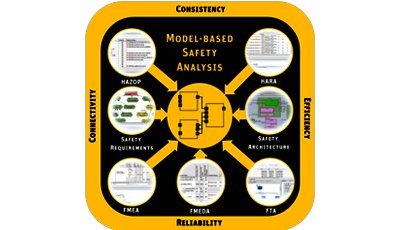
Find and solve safety-critical issues in your systems and components using inductive and deductive methods directly tied to your design models.
Reliability Prediction and Analysis
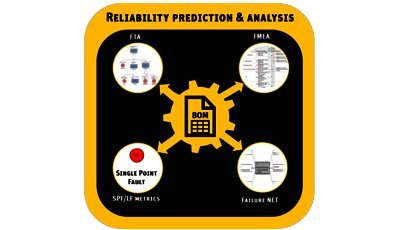
Evaluate the safety and reliability of your H/W design utilizing well-established standard reliability handbooks and widely used quantitative analysis methods like FT, FMEDA and FMECA.
- Solder joint reliability to assure a product will function under given conditions, for a specified time, without exceeding defined failure levels
- Plated through-hole fatigue by using computerized modeling and temperature maps instead of human interfaces for accurate finite element test results
- Strain measurement during shock and vibration testing to gather data for prediction of failure probability, root causes of failure and failure events
- Material selection to align a plastic’s properties with design and functionality requirements
- Supplier analysis for building partnerships that can consistently deliver quality products and services without interruption
- Post-assembly handling operations assessment to identify areas for efficiency improvement after production
- Semiconductor wear-out, which allows manufacturers to evaluate and predict IC failures using an approach that follows SAE ARP 6338
Validate the standard compliance of your safety concepts with automatic constraint checking; establish rich traceability for impact analysis.

Traceability and Validation
Teamwork and Review Support
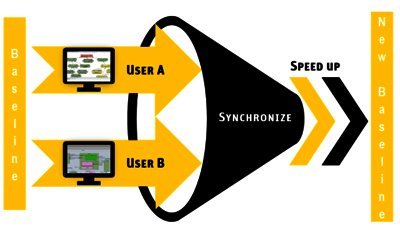
Collaborate as a safety engineering team by sharing, comparing and merging safety projects; integrate with task management systems for workflow support.
- Project compare with two-way and three-way difference analysis.
- Project merge functionality for team collaboration.
- Creation of tasks/comments for arbitrary model elements.
- Navigation from tasks to elements and vice versa.
- Context visualization for active tasks.
- Documentation of all decisions at the tasks, scheduling, user assignment and email notifications levels.
- Integration with configuration management systems (TortoiseSVN, IBM® Rational® ClearCase®, PTC Integrity, etc.).
- Integration with task and issue tracking systems (e.g., Bugzilla, Trac, PTC, Redmine, Jira, etc.).
Integration into the Engineering Environment
Seamlessly exchange engineering data like requirements, design models, and part libraries with standard requirements management and system design tools.
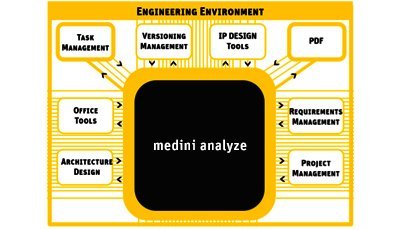
- Seamless connection to system modeling, requirements management, task management and configuration management tools
- Integration with the requirements management solutions IBM® Rational® DOORS®, PTC Integrity™ and JAMA Software, including custom attribute and relationship mappings
- Full RIF/ReqIF support for round-trip with other third-party requirement solutions
- Excel and MSR-FMEA import and export (e.g., APIS IQ-FMEA, PLATO SCIO™)
- Integration with IBM® Rational® Rhapsody®, Sparx Enterprise Architect, MATLAB/Simulink, Stateflow® and Ansys SCADE Architect for exchange of system models
- Integration with configuration management solutions (e.g., TortoiseSVN, IBM® Rational® Team Concert, IBM Rational ClearCase and many more)
- Import and update of bill of materials (BOM) data via Excel
- Import chip-level design data (IP Design) via the IPD-XML format from tools like Cadence® Functional Safety Simulator or Optima Fault Injection Engine™
- Export to various document formats including Microsoft® Word, Excel, PDF and HTML
- Scripting API to connect other engineering tools to individual needs
Customisation and Process Adaptation
Easily adapt medini analyze to company-specific processes, guidelines and templates.
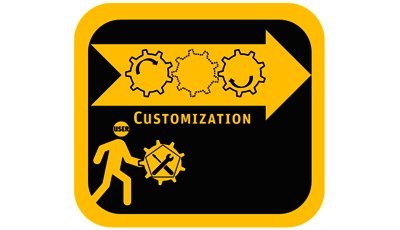
- Customization of the tool data model and editors to corporate needs by profiling mechanism (attributes, references, queries).
- Checklists for tracking of process activities according to corporate workflows.
- Project template mechanism that allows set up of corporate best practice model/data management and storage.
- Direct integration with requirements and task management systems to track analysis results (e.g., IBM® Rational® DOORS®, PTC Integrity™, JAMA Software, No Magic MagicDraw®, Redmine, etc.)
- Scripting API to automate tedious task and workflow steps (e.g., model transformations, consistency checks, tool integrations).
- Adaptable reporting and export capabilities.
Ansys Product Integration
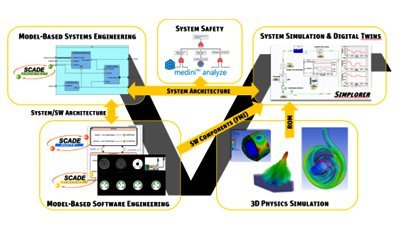
Benefit from the tight coupling of medini analyze with other Ansys tools for system design, analysis, and simulation.
Integration with Ansys SCADE Architect
With this integration, any changes in system architecture are easily and seamlessly translated from SCADE Architect to medini analyze. This tight integration eliminates the possibility of human error as electronics systems are modeled, verified and updated. The same reliable, step-by-step process will ensure the creation of system architectures that meet all relevant industry standards for safety and control — quickly and cost-effectively.
Integration with Ansys RedHawk-SC
RedHawk-SC is able to produce the IPD-XML format to import IP-design information into medini analyze for functional safety analysis on the semiconductor level. With this integration, the FMEDA workflow for semiconductor chip designs is supported.
Reporting and Documentation
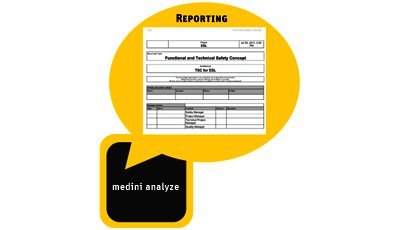
- Rich default reporting capabilities for all created work products of medini analyze, including HARA, FMEA, FMEDA, FTA, checklists, safety goals and requirements and system design.
- Direct export of all table data to Excel.
- Customizable work product and documentation generation based on report template engine.
- Export of all project data to XML for long-term storage and post-processing.
- Support of diverse document formats such as Word, Excel, PDF, HTML and more.